Yellowstone County Dog Registration Information
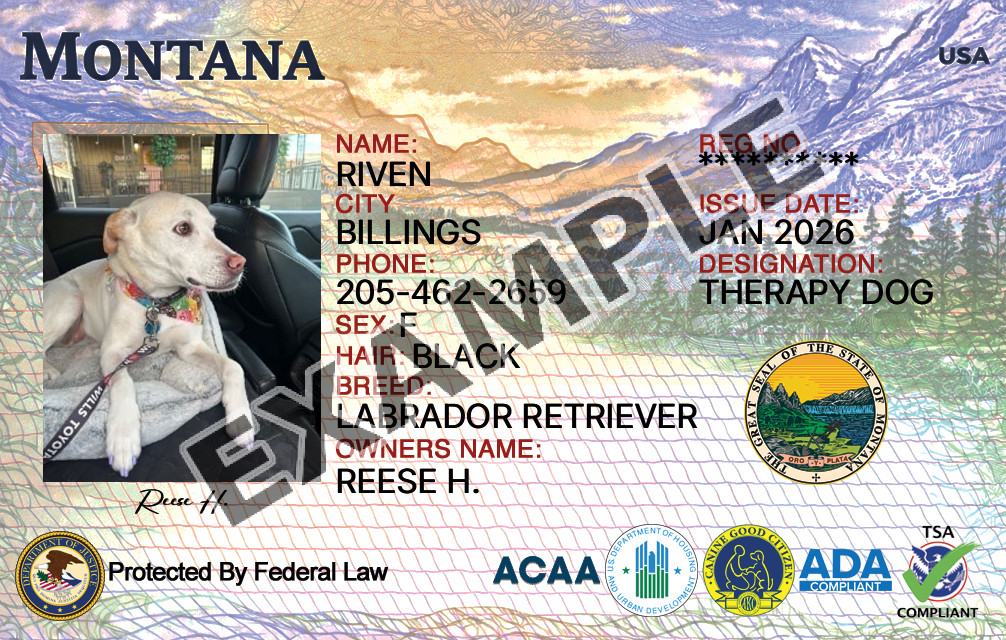
Service Dogs and Emotional Support Animals in Yellowstone, Montana
If you’re searching “where do I register my dog in Yellowstone County, Montana for my service dog or emotional support dog”, the key thing to know is that there are usually two separate topics involved: (1) local dog licensing (often tied to rabies vaccination requirements and local ordinances), and (2) your dog’s service dog or emotional support animal (ESA) status under federal and state law. This page explains how dog licensing in Yellowstone County, Montana typically works, which local offices to contact, and why there is no single universal federal “registration” for service dogs or ESAs.
Where to Register or License Your Dog in Yellowstone County, Montana
In Yellowstone County, dog licensing requirements can depend on whether you live inside a city that has its own licensing ordinance (such as Billings or Laurel) versus elsewhere in the county. Below are official offices that serve residents of Yellowstone County for animal control services and/or dog licensing.
Billings Animal Control (City of Billings)
City of Laurel – City Hall (Dog Licenses for Laurel Residents)
Yellowstone County Sheriff’s Office (County Animal Control / Non-Emergency)
Use this contact for county animal control concerns (such as stray/at-large dogs, injured animals, livestock concerns, or requesting an animal control officer) outside city-specific services.
About licensing outside city limits
Some Yellowstone County residents live in areas where city licensing ordinances do not apply the same way (or at all). If you are not within Billings or Laurel city limits, contact the Yellowstone County Sheriff’s Office (above) and your local municipality (if you live in another incorporated town) to confirm whether a countywide dog license is required, and which office issues it.
Overview of Dog Licensing in Yellowstone County, Montana
Dog licensing is usually local (city or municipality-based)
When people ask “where to register a dog in Yellowstone County, Montana,” they often mean getting a dog license—a local registration that helps a city or jurisdiction track animals, encourage rabies compliance, and assist with reunification if a pet is lost. In Yellowstone County, licensing requirements can differ based on city limits and local ordinances.
Billings residents: licensing is tied to city ordinance
If your address is within Billings city limits, Billings Animal Control indicates that city ordinance requires dogs/cats kept in the city to be registered, and you can contact Billings Animal Control for details on licensing. If you’re specifically looking for an animal control dog license in Yellowstone County, Montana and you live in Billings, Billings Animal Control is a primary official contact.
Laurel residents: licenses are purchased at City Hall
If you live within Laurel, the City of Laurel states that dog licenses can be purchased at Laurel City Hall. Laurel’s published information also notes licensing is annual and that fee amounts can vary based on timing and whether a dog is spayed/neutered.
Outside Billings or Laurel
If you live in Yellowstone County but not within a city’s incorporated boundaries (or you live in a different municipality), confirm your local requirements. A good starting point is the Yellowstone County Sheriff’s Office for animal control guidance and direction to the correct licensing authority (if one applies where you live).
| Category | What it is | Who sets the rules | Typical proof/documentation | Public access rights |
|---|---|---|---|---|
| Dog license | A local registration for dogs (and sometimes cats) that may be required to keep a pet within certain city limits. | Local government (city/municipality; sometimes county rules apply depending on location). | Often includes proof of current rabies vaccination; may include spay/neuter status and owner information. | No special rights. It does not grant access to non-pet areas; it is a compliance/identification mechanism. |
| Service dog | A dog individually trained to do work or perform tasks for a person with a disability (task training is the core requirement). | Federal disability law governs public-access standards; local animal control rules (like rabies vaccination) can still apply. | No single universal federal registry. Businesses typically may ask limited questions (e.g., whether the dog is required because of a disability and what task it is trained to perform), not demand “registration papers.” | Generally has public access to places of public accommodation where pets are not allowed, subject to behavior and control requirements. |
| Emotional support animal (ESA) | An animal that provides comfort by its presence and helps with emotional or psychological symptoms. It is not task-trained like a service dog. | Typically addressed under housing-related rules (not general public access). Local licensing rules may still apply depending on your location. | Commonly supported by documentation from a healthcare provider for housing needs (requirements can vary by situation). | No general public access rights like a service dog; access depends on the setting (e.g., pet policy). |
What You Need Before Registering a Dog
Common dog licensing requirements in Yellowstone County, Montana (by jurisdiction)
While exact requirements vary by city, most dog licensing processes are straightforward. In general, be prepared for:
- Rabies vaccination certificate (current and issued by a veterinarian)
- Owner identification (and sometimes proof of address/residency)
- Spay/neuter documentation if the fee schedule differs for altered vs. unaltered animals
- Payment for licensing fees (fees can vary by jurisdiction and animal status)
Why rabies documentation matters
Many local licensing programs are built around rabies compliance and identification. Even when your dog is a service dog or emotional support animal, local rules may still require that the animal is appropriately vaccinated and, where applicable, licensed.
Steps to Register or License a Dog in Yellowstone County, Montana
Step 1: Confirm your jurisdiction (Billings, Laurel, or elsewhere)
- In Billings city limits: Contact Billings Animal Control for licensing guidance and current requirements.
- In Laurel city limits: Purchase your dog license at Laurel City Hall.
- Elsewhere in Yellowstone County: Call the Yellowstone County Sheriff’s Office non-emergency line for animal control guidance and to confirm whether your location has a licensing requirement and which office administers it.
Step 2: Gather documents
Collect your rabies vaccination certificate and any spay/neuter documentation you may have. If you recently moved, have your current address information available as well.
Step 3: Submit the application / purchase the license
Depending on the jurisdiction, you may be able to obtain a license in person during office hours. Keep the license information for your records and follow any local rules about tags (for example, whether the dog must wear a city license tag when off your property).
Step 4: Renew on schedule
Many city licenses renew annually (some places may offer multi-year options). Renewal timing, fees, and discounts can vary—confirm with your city office.
Service Dog Laws in Yellowstone County, Montana
No single universal federal service dog registry
If you are trying to “register” a service dog, it’s important to separate legal status from local licensing. Under federal disability law, a service dog’s status comes from training to perform tasks for a person with a disability—not from an online registration number or certificate. You can still be subject to local rules like leash control, vaccination, and (where required) a dog license in Yellowstone County, Montana based on where you live.
Local licensing still may apply
Even if your dog is a service dog, you may still need to comply with local licensing ordinances where you reside (for example, within a city that requires dogs to be licensed). If you live in Billings, Billings Animal Control is the official point of contact for local animal registration requirements within city limits.
Emotional Support Animal Rules in Yellowstone County, Montana
ESA status is not the same as a service dog
An emotional support animal (ESA) can play an important therapeutic role, but ESAs are generally not treated the same as service dogs in public places. ESA recognition most commonly comes up in housing contexts, not in general public access. For everyday purposes—like living within a city that requires licensing—you should still plan to meet local requirements (such as rabies vaccination proof and licensing where required).
Local licensing is separate from ESA documentation
If your goal is compliance with local animal ordinances, focus first on whether your address falls under Billings, Laurel, or another jurisdiction’s requirements. Then complete the relevant licensing steps with the appropriate official office.
Frequently Asked Questions
What You May Need
Local terms people search
If you’re comparing options for where to register a dog in Yellowstone County, Montana, keep in mind that local agencies may use terms like “license,” “registration,” or “animal license” for the same process.
- dog license in Yellowstone County, Montana
- animal control dog license Yellowstone County, Montana
- where to register a dog in Yellowstone County, Montana
- dog licensing requirements Yellowstone County, Montana
Register A Dog In Other Montana Counties
Select your county below to get started with your dog’s ID card. Requirements and license designs may vary by county, so choose your location to see the correct options and complete your pup’s registration.
- Beaverhead Dog License Cards
- Big Horn Dog License Cards
- Blaine Dog License Cards
- Broadwater Dog License Cards
- Carbon Dog License Cards
- Carter Dog License Cards
- Cascade Dog License Cards
- Chouteau Dog License Cards
- City of Anaconda Dog License Cards
- City of Butte Dog License Cards
- Custer Dog License Cards
- Daniels Dog License Cards
- Dawson Dog License Cards
- Deer Lodge Dog License Cards
- Fallon Dog License Cards
- Fergus Dog License Cards
- Flathead Dog License Cards
- Gallatin Dog License Cards
- Garfield Dog License Cards
- Glacier Dog License Cards
- Golden Valley Dog License Cards
- Granite Dog License Cards
- Hill Dog License Cards
- Jefferson Dog License Cards
- Judith Basin Dog License Cards
- Lake Dog License Cards
- Lewis and Clark Dog License Cards
- Liberty Dog License Cards
- Lincoln Dog License Cards
- Madison Dog License Cards
- McCone Dog License Cards
- Meagher Dog License Cards
- Mineral Dog License Cards
- Missoula Dog License Cards
- Musselshell Dog License Cards
- Park Dog License Cards
- Petroleum Dog License Cards
- Phillips Dog License Cards
- Pondera Dog License Cards
- Powder River Dog License Cards
- Powell Dog License Cards
- Prairie Dog License Cards
- Ravali Dog License Cards
- Richland Dog License Cards
- Roosevelt Dog License Cards
- Rosebud Dog License Cards
- Sanders Dog License Cards
- Sheridan Dog License Cards
- Silver Bow Dog License Cards
- Stillwater Dog License Cards
- Sweet Grass Dog License Cards
- Teton Dog License Cards
- Toole Dog License Cards
- Treasure Dog License Cards
- Valley Dog License Cards
- Wheatland Dog License Cards
- Wibaux Dog License Cards
